
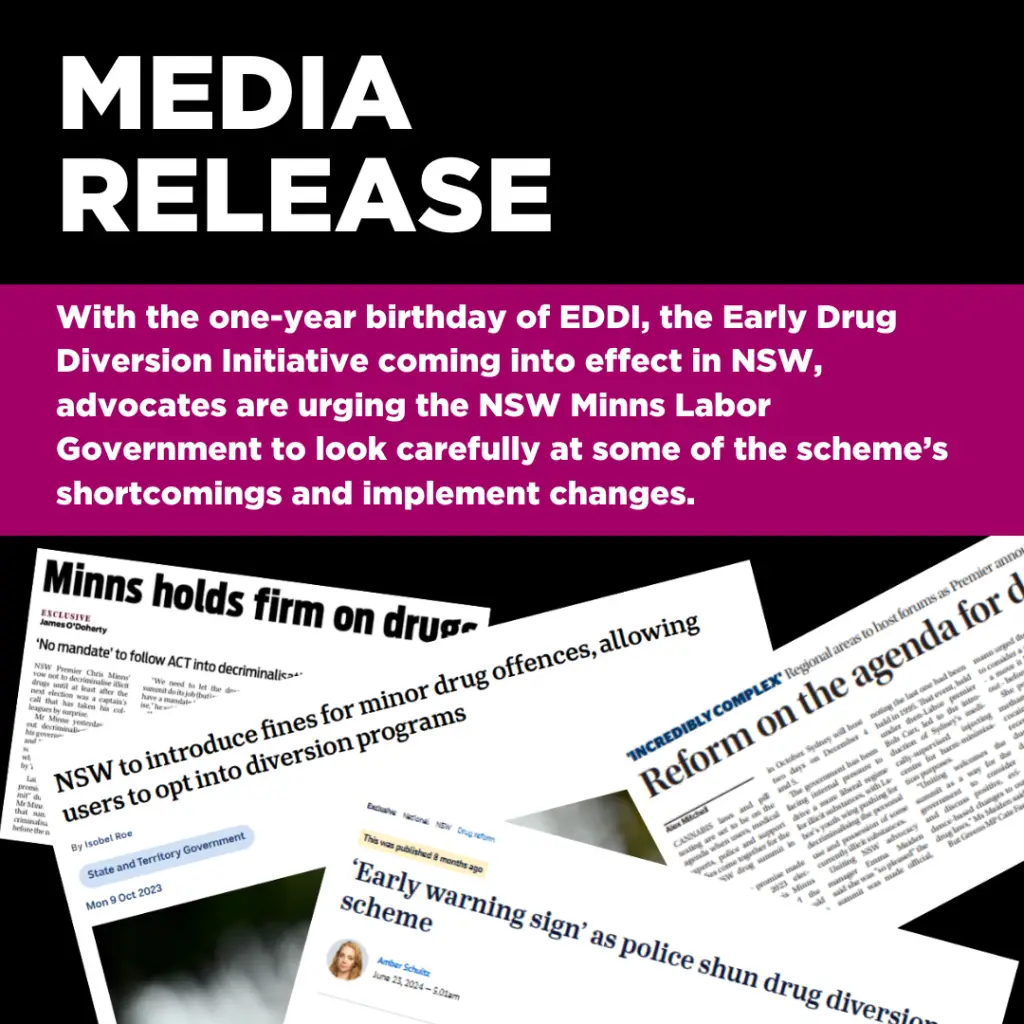
With the one-year birthday of EDDI, the Early Drug Diversion Initiative, coming into effect in NSW, advocates are urging the NSW Minns Labor Government to look carefully at some of the scheme’s shortcomings and implement urgent changes.
EDDI came into effect on the 29th February last year with the aim to address some of the harms caused by our unfair drug laws.
“Unfortunately, the implementation of EDDI has been a disappointing missed opportunity, many people had hoped for better for those they love who are living with drug dependency,” Alice Salomon, Uniting NSW.ACT’s Head of Advocacy said.
“Any positive change to the way we approach drug use and dependency in NSW is always welcome – but we know that the chance for diversion through EDDI is being delivered unevenly across the state.
“Preliminary data shows that EDDI is more available for those who use cocaine or MDMA and those who aren’t First Nations, making EDDI a system that favours those with privilege. People who would be more likely to be able to afford a lawyer are also more likely to receive diversion rather than a Court date.
“So instead of creating pathways to treatment for people who are experiencing drug dependency, EDDI has continued to treat the people who could benefit most from that approach as criminals, with all the harm, shame and stigma that goes with that.
“It’s clear that NSW needs evidence-based, equitable and inclusive diversion programs which will result in better outcomes for people. This means all people should be eligible to access them, including First Nations people, those without means, younger people and people with prior convictions,” Alice said.
“A fairer diversion model should also have no or low fines and no limit to the number of times a person can be diverted. A limited number of ‘strikes’ could exclude a person experiencing drug dependency – someone who is more likely to benefit from a health and welfare response.
“Let’s be clear – everyone, no matter where you live, your race, which drug is in your pocket or your life circumstances, should have access to a health and welfare response. They should be able to be diverted away from the criminal justice system through the EDDI scheme for possessing a small amount of drugs for personal use.
“The vast majority of the community, as revealed in survey after survey, supports this approach,” Alice said.
“We are hopeful that the NSW Drug Summit report will, amongst other important measures, recommend that the Government address the inequity of access to EDDI.
“It will also look at whether the penalty for drug possession should be changed to either a caution or diversion to an escalating health and welfare response should the circumstances indicate, this could be helpful,” Alice said.
Samantha Lee, Supervising Solicitor at Redfern Legal Centre said: “Just a week after the NSW Drug Summit, I had two clients charged with minor drug possession. They were issued with Court Attendance Notices, even though they had no criminal record and the amount of drugs involved was so low that a diversion should have been the first course of action.
“Instead, my clients face a lengthy and stressful court process.
“I hope that, in the end, they can avoid a conviction and a criminal record, which could have detrimental consequences for their work and travel opportunities,” Samantha said.
Community support for health and welfare-based responses to drug use continues to grow, as revealed last year by the Australian Institute of Health and Welfare (AIHW) in the National Drug Strategy Household Survey.
Uniting commissioned polling last year in 5 key seats in NSW, which revealed that 74%, or three out of four NSW residents support health responses to drug use.
Uniting runs the Medically Supervised Injecting Centre and has spearheaded the Fair Treatment campaign for fairer drug laws for over six years.
| Media contact: | Andrew Bradley E-mail: abradley@uniting.org |