
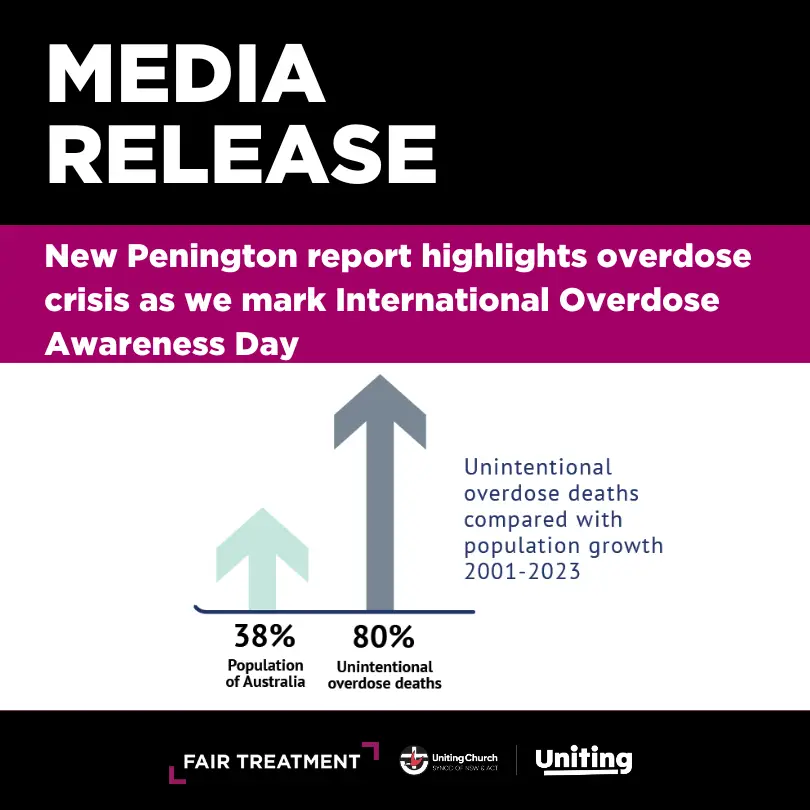
A new report by the Penington Institute released today reveals the current scale of Australia’s overdose crisis as we also mark International Overdose Awareness Day.
Alice Salomon, Head of Advocacy at Uniting NSW.ACT said: “According to data released today by the Penington Institute, we are losing more than six people to overdose every day – these deaths are still too high – highlighting the urgent need for change right across Australia.
“Today’s report shows that the overdose crisis saw 2,272 people die from overdose in the latest year of data. This is the equivalent to losing in excess of a Boeing 737 full of Australians each month – and that 80% of the overdose toll is accidental – these are shocking figures,” Alice said.
The report finds that the “latest figures mark the tenth consecutive year that overdose deaths have exceeded 2,000, and the 16th straight year that overdose fatalities have exceeded the road toll.”
“The report highlights the overdose crisis is increasingly affecting older Australians and that Indigenous Australians are dying at a rate of more than three and a half times that of non-Indigenous Australians.
“As parents, as partners, as brothers and sisters, and sons and daughters, we each share a common desire: for all the people we love to be kept safe and free from harm.
“With overdose deaths already alarmingly high, there is an urgent need for Governments across Australia to prepare and respond effectively,” she said.
“International Overdose Awareness Day is not only a tribute to those lost but also a rallying cry for investment in the services that save lives and an end to punitive policies that cause harm.
“Every overdose death is a preventable one. There are sensible, evidence based and fair solutions that we know work and save lives which could be implemented today. The people of NSW cannot wait any longer,” Alice said
“These include improvements to existing diversion programs to enable a health and wellbeing response to drug use, equipping police with naloxone to reverse opioid-related overdoses and amending legislation to allow for more communities to apply for medically supervised injecting facilities.
“We again repeat our calls for the NSW Government to respond swiftly to the detailed report from last year’s Drug Summit with a detailed plan, and the required funding to implement the report’s recommendations,” she said.