
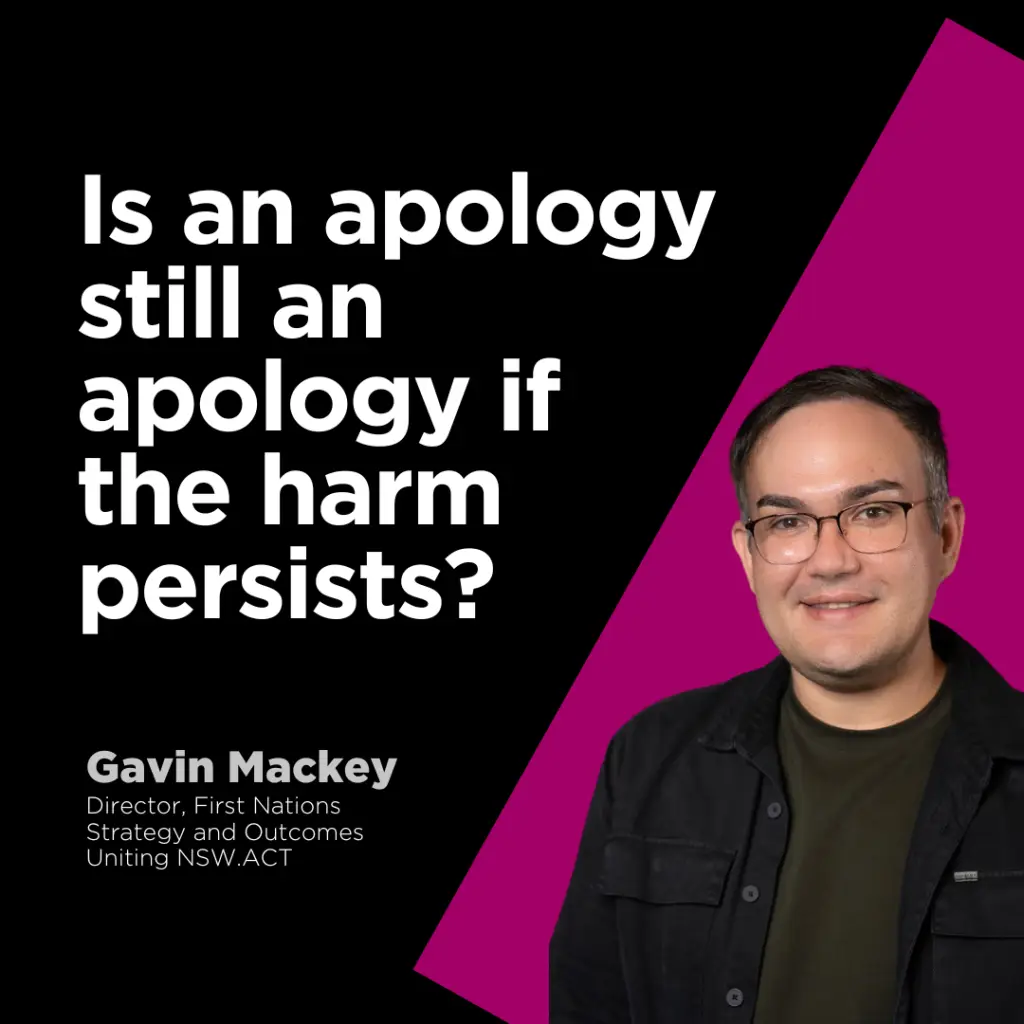
Written by Gavin Mackey
Eighteen years ago, the Australian Parliament stood still as Prime Minister Kevin Rudd delivered a formal apology to the Stolen Generations. It was a moment of profound hope, a promise that the “injustices of the past must never, never happen again” …
“A future where all Australians, whatever their origins, are truly equal partners, with equal opportunities and with an equal stake in shaping the next chapter in the history of this great country, Australia.”
[Kevin Rudd, MP (Prime Minister) Hansard – Apology to Australia’s Indigenous peoples 13 February 2008]
But as we mark this anniversary on 13 February 2026, nearly two decades on, we must ask: Is an apology still an apology if the harm persists?
The National Apology acknowledged the Stolen Generations, but intergenerational trauma continues. Many families are still carrying the weight of forced removals, still needing support to heal from ongoing separation, surveillance, and control.
Close the gap tells us that because of the surveillance and control of the Stolen Generations, we see health gaps such as reduced life expectancy, continued removals, and disproportionate response to personal drug use.
Substance-use dependency is not a moral failure or a criminal choice. It is a health and wellbeing issue shaped by trauma and structural neglect.
Through our drug law reform work [the Fair Treatment campaign], we understand that trauma is a primary driver of substance use as self-medication to cope with psychological distress and the effects of intergenerational trauma. For the First Nations community members who we support through our advocacy, this cycle of trauma is perpetuated by the very injustices our nation apologised for.
And while the public is increasingly supportive of treating substance use as a health system priority, our justice system is moving in the opposite direction for First Nations communities. Recent data from the NSW Bureau of Crime Statistics and Research (BOCSAR) reveals a chilling reality:
• In the past decade, drug possession charges against non-Indigenous people have fallen by 22%.
• In the same period, legal actions against Aboriginal people for the same offences have skyrocketed with an increase of 62%.
In 2024–25, we saw a “Diversion Gap” that should disappoint every policymaker. When a non-Indigenous teenager is found with a small amount of a prohibited substance, they have a 77% chance of receiving a police caution. For an Aboriginal teenager, that drops to 52%.
This is not due to higher usage rates; it reflects where we choose to police and who we choose to forgive.
The evidence is not complicated. What is complicated is the refusal to close this gap. Drug-arrest data often tells us more about where police patrol, who gets stopped, and who gets searched, rather than who is manufacturing and importing drugs. Over-policing creates the “data” that then “justifies” more policing, a cycle that must be reviewed to eliminate systemic racial discrimination.
A drug charge leads to a criminal record. A criminal record leads to job loss and housing instability. For First Nations parents, this often results in the intervention of child protection services. In some jurisdictions, our children are more than twenty times more likely to be removed from their families and placed in the out-of-home care system.
By continuing to use punitive drug laws to address what is fundamentally a mental-health issue, we are effectively creating a “Modern Stolen Generation.” We are separating parents from children and children from culture, all under the guise of “law and order.”
The National Apology was a defining moment for truth-telling, but truth without action feels performative.
We cannot “Close the Gap” while incarceration rates for First Nations adults are rising by 12% year on year. We cannot talk about healing and reconciliation while we criminalise pain and treat dependency as a personal failure instead of a health issue.
The most transformative lever for closing the gap for policymakers exists in the evidence available within the very organisations and systems they govern.
When health-led diversion is available and police still default to punishment, the system is choosing the very model we apologised for nearly two decades ago. This raises the question: Do we all get a “fair go”?
This year, Uniting Fair Treatment advocates for the NSW Government to reaffirm the Early Drug Diversion Initiative policy as intended.
We call for the NSW Government to:
- Mandate Equal Rights in Diversion: Police should not have the discretion to deny a health-led caution based on postcode or heritage.
- Fund Community-Led Healing: Invest the millions currently spent on First Nations incarceration into Aboriginal-controlled health services.
An apology is not the end of the story. Healing, restoring culture, and rebuilding lives fractured by intergenerational trauma is long, unfinished work.
This anniversary should not be about symbolic reflection. It should be about accountability – about whether this country is finally prepared to match words with action.
We need our politicians to lead this shift in perspective, and then collectively we can begin to honour the history and truth that compelled Australia’s Prime Minister to deliver the apology to the Stolen Generations nearly two decades ago.

Gavin Mackey is the Director of First Nations Strategy and Outcomes at Uniting NSW.ACT